Most auto repair marketing campaigns are built around a simple model: build a list, send a message, wait, and send another message.
That approach can work, but it treats every customer the same.
The customer who just spent $2,500 on a major repair should not receive the same marketing message as a customer who has not visited the shop in 14 months. A customer who declined a recommended service should not be treated the same as someone who has never been offered that service. And a customer who just clicked an email or responded to a text has given you a signal that should influence what happens next.
This is where adaptive marketing becomes powerful for auto repair shops.
Instead of creating campaigns where every customer receives the same sequence of messages, an adaptive CRM campaign responds to what the customer does and automatically changes the next communication.
The customer’s behavior should determine what happens next.
What Is Adaptive Marketing?
Adaptive marketing is a strategy where marketing changes based on real-time signals, customer behavior, and changes in the customer’s relationship with the business.
For an auto repair shop, those signals can be especially valuable because the shop already has a significant amount of customer and vehicle information. Service history, vehicle information, declined work, visit frequency, customer value, and communication history can all provide clues about what a customer may need next.
Instead of asking, “What campaign should we send this month?” an adaptive marketing strategy asks a better question:
What does this customer need next, and what should we do if they don’t respond?
That shift changes marketing from a series of scheduled messages into an ongoing conversation with the customer.
Why Adaptive Marketing Works for Auto Repair Shops
Traditional marketing campaigns are often built around a fixed sequence. A shop might send an email, wait 30 days, send another email, and then send a final reminder.
The problem is that the campaign may not know what happened between those messages.
Did the customer open the email? Did they click the offer? Did they call the shop? Did they schedule an appointment? Did they ignore the message entirely?
When the campaign continues regardless of the customer’s behavior, the shop is missing valuable information.
Adaptive marketing creates a feedback loop:
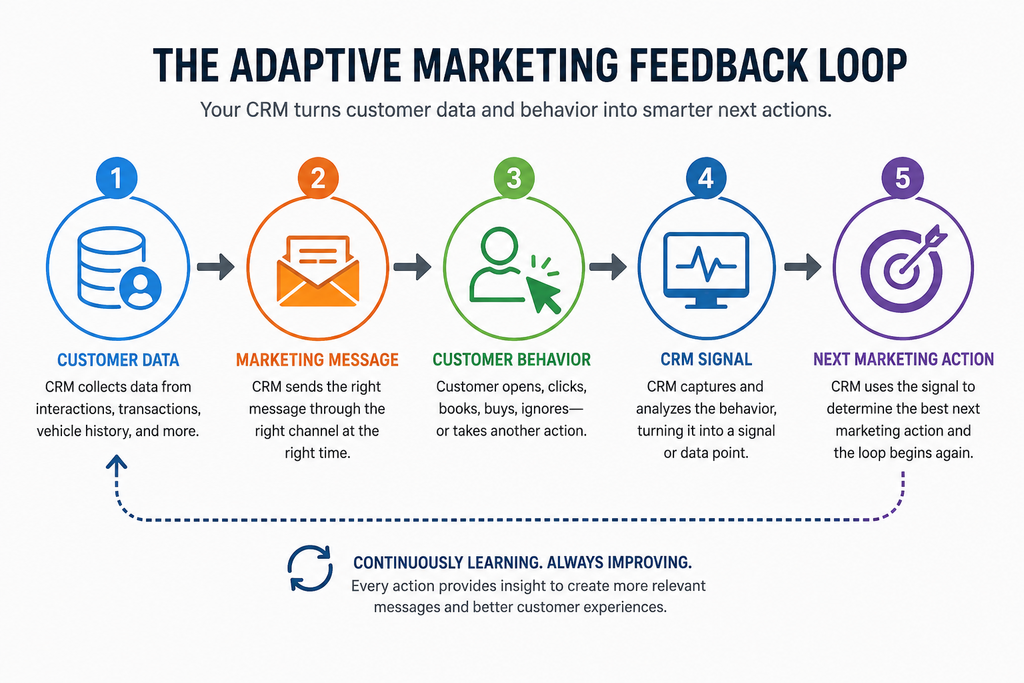
That feedback loop allows the campaign to continuously respond to the customer.
Instead of simply automating communication, the CRM uses each interaction to determine what should happen next.
What Adaptive Marketing Can Do
An adaptive campaign can automatically:
- Change the next message based on customer behavior
- Stop marketing when a customer schedules an appointment
- Move a customer into a different campaign
- Delay communication when the timing is not right
- Follow up differently with engaged and unengaged customers
- Use service and vehicle history to personalize messaging
- Prioritize customers based on value or opportunity
- Measure which customer behaviors lead to revenue
The result is a marketing system that reacts instead of simply repeating the same sequence.
The Customer Signals Your CRM Should Be Watching
The foundation of adaptive marketing is data. But having a large amount of data is not enough. The important part is identifying the signals that can actually change a marketing decision.
Service History
A customer’s previous services can help determine what marketing they should receive next.
Someone who recently had their brakes replaced may need different communication in the future than a customer who has never had brake service. When service history becomes part of the marketing strategy, campaigns become more relevant because they are based on the customer’s actual relationship with the shop.
Vehicle Age and Mileage
Vehicle information provides another important signal.
Vehicle age, mileage, previous repairs, and recommended maintenance can help a shop identify when certain services may become relevant. Combining these signals creates a much more useful picture than simply looking at how long it has been since the customer’s last visit.
Declined Work
Declined work may be one of the most valuable signals an auto repair CRM can capture.
When a customer declines a recommended service, that does not necessarily mean they will never purchase it. They may need more information, may not have had the budget at the time, or may simply need another reminder.
Instead of recording the declined service and forgetting about it, an adaptive campaign can use that event to create a future sales opportunity.
For example, a customer who declines brake replacement could receive an educational message about the importance of the service. If they engage with that message, the next communication can focus on scheduling. If they do nothing, the customer can move into a longer-term follow-up campaign. Once the customer schedules or completes the service, the CRM can remove them from the campaign.
The campaign changes because the customer changed.
Customer Lifecycle
Customers also move through different stages of their relationship with a shop.
An active customer should not receive the same message as someone who has been gone for more than a year. Likewise, a customer who has historically visited several times a year but has suddenly stopped coming in may deserve more attention than someone who has always been an occasional customer.
A CRM can use lifecycle information to determine whether a customer should receive:
- Retention messaging
- Maintenance reminders
- Reactivation messaging
- Win-back campaigns
- Service-specific follow-up
Customer Engagement
Engagement provides another important signal.
Consider two customers who receive the same email. One opens the message and clicks the appointment link. The other never opens it.
Those customers have demonstrated different levels of interest, so there is little reason to send them the same follow-up.
An adaptive campaign can recognize the difference and change the next communication accordingly.
Adaptive Marketing Strategies for Auto Repair Shops
Adaptive Service Reminder Campaigns
Service reminders are a natural starting point for adaptive marketing because the timing and content of the message can be influenced by the customer’s actual service history.
Rather than sending every customer a generic maintenance reminder, a shop can build campaigns around the services a customer has previously received, the vehicle they drive, and the amount of time since their last visit.
For example, a customer approaching a maintenance interval could receive a reminder based on their vehicle and service history.
If they schedule an appointment, the campaign stops.
If they open the message but do not schedule, the next message can provide additional information or a stronger call to action.
If they do nothing, the campaign can wait and try a different approach later.
The important part is that the customer determines the next step.
Adaptive Declined-Service Campaigns
Declined work creates another powerful opportunity.
Imagine that a customer comes into the shop and declines a recommended brake service. A traditional CRM may simply record the recommendation as declined.
An adaptive CRM can do much more.
The declined service becomes the starting signal. The campaign might:
- Send educational information about the recommended service.
- Monitor whether the customer engages.
- Send an appointment-focused message if they show interest.
- Move them into a longer-term follow-up campaign if they do not respond.
- Stop the campaign when the customer schedules or completes the service.
This approach gives shops a way to continue working opportunities that would otherwise disappear after the customer leaves the building.
Adaptive Lapsed Customer Campaigns
Customer reactivation is another area where adaptive marketing can make a significant difference.
Not every inactive customer should receive the same “We miss you” email.
A customer who is only slightly overdue may simply need a maintenance reminder. A customer who normally visits several times a year but has suddenly gone inactive may need a more personalized message. Someone who has been gone for several years may require a stronger reactivation offer.
The CRM can use the customer’s history to determine which approach makes the most sense.
This is important because effective retention marketing is not simply about sending more reminders. It is about recognizing where the customer is in the relationship and communicating accordingly.
Adaptive Marketing Based on Vehicle Data
The vehicle itself can also become a marketing signal.
A customer’s vehicle make, model, age, mileage, service history, and previous recommendations can all help determine which marketing messages are relevant.
For example, two customers may both be 12 months removed from their last visit, but their vehicles may have very different maintenance needs.
When the CRM combines customer information with vehicle information, the shop can move away from generic marketing and toward communication that is much more relevant to the individual customer.
Adaptive Marketing Should Work Across Email and SMS
Adaptive marketing should not stop at email.
A customer may ignore an email but respond to an SMS. They may click a message and then call the shop. They may schedule an appointment without ever engaging with the campaign directly.
Those interactions matter.
When communication history is connected to the CRM, the shop has a better understanding of what has already happened with the customer. That information can then influence future marketing.
One Customer, Multiple Signals
A customer might:
- Ignore an email
- Respond to an SMS
- Click an appointment link
- Call the shop
- Schedule an appointment
- Return for service
An adaptive CRM should be able to recognize those actions as part of the same customer relationship.
This is where a CRM becomes more than an email marketing platform.
It becomes the system coordinating the customer relationship.
How HiBeam Enables Adaptive Marketing
HiBeam is built around the idea that customer data should do more than sit inside a database.
It should help the shop determine what happens next.
HiBeam can bring together customer information, vehicle data, service history, segmentation, communication, and campaign automation so shops can create marketing campaigns that respond to customer behavior.
Customer Segmentation
Effective adaptive marketing starts with identifying meaningful groups of customers.
Instead of building one large marketing list, shops can segment customers based on factors such as:
- Lifecycle stage
- Service history
- Vehicle information
- Customer value
- Declined work
- Location
- Engagement
Those segments provide the starting point for more relevant campaigns.
Campaign Automation
Once the audience has been identified, automation can determine when and how customers are contacted.
But the goal is not simply to automate a fixed sequence.
The goal is to create campaigns that can branch based on what the customer does.
That might mean changing the next message, delaying communication, moving the customer into another campaign, or removing them completely after an appointment is scheduled.
Customer Scoring
Customer scoring can add another layer to adaptive marketing.
A customer with a long history at the shop, high historical spending, recent engagement, and outstanding recommended work may deserve a different marketing approach than someone with limited history.
Scoring can help shops identify which customers and opportunities deserve additional attention.
Communication History
A customer’s communication history is also important.
When email, SMS, and other customer interactions are connected to the CRM, the shop can see more of the relationship in one place.
That makes it easier to avoid sending irrelevant or repetitive messages and gives future campaigns more context.
Building an Adaptive Campaign in HiBeam
The process starts with a customer signal.
For example, suppose a customer declines a recommended service.
That event can trigger the campaign. The first message provides useful information about the service. From there, the customer’s behavior determines the next step.
If they engage, the campaign can move toward conversion. If they ignore the message, the CRM can wait and try another approach. If they schedule the service, the campaign can automatically end.
The process can be summarized as:
Signal → Action → Customer Response → Next Action → Conversion → Measurement
A Simple Adaptive Campaign Framework
When building an adaptive campaign, think through five questions:
- What triggers the campaign?
- What should the customer receive first?
- What customer behavior changes the next step?
- What event ends or changes the campaign?
- What business outcome are you measuring?
Answering these questions turns a basic automated campaign into a customer-driven workflow.
The Difference Between Automation and Adaptive Automation
This distinction is important because automation by itself does not make a campaign adaptive.
A basic automated campaign might say:
If a customer is inactive for 12 months, send an email.
An adaptive campaign goes further.
The customer receives the email. If they open it but do not schedule, they receive a different follow-up. If they click, the campaign can move toward an appointment-focused message. If they schedule, the customer is removed from the campaign. If they do nothing, the campaign can wait and try a different message later.
Both campaigns are automated.
Only one is adapting to the customer.
Static vs. Adaptive Campaigns
| Static Automation | Adaptive Automation |
| Same sequence for everyone | Sequence changes by customer behavior |
| Based primarily on time | Based on time and customer signals |
| Limited response to engagement | Responds to engagement |
| Customer stays in the same campaign | Customer can move between campaigns |
| Often stops after the sequence ends | Can continue responding to new signals |
| Focuses on sending messages | Focuses on driving the next action |
The difference is not whether the campaign is automated. The difference is whether the automation can make a different decision based on what the customer does.
Measuring Adaptive Marketing
The ultimate goal of adaptive marketing is not to send more emails or generate more clicks.
It is to generate more revenue from the customer relationships the shop already has.
That means campaigns should be measured against business outcomes.
Revenue is one of the most important measures because it connects marketing activity to the bottom line. But shops should also look at:
- Appointment conversions
- Service conversions
- Customer reactivation
- Average repair order
- Customer retention
- Revenue per customer
- Campaign-attributed revenue
The value comes from comparing those results across different customer segments and campaign approaches.
For example, a shop might discover that one message works extremely well with recently lapsed customers but performs poorly with long-term lost customers. Instead of continuing to send the same campaign to everyone, the shop can adapt the strategy for each group.
That creates another feedback loop:
Campaign results → Insight → Campaign adjustment → Better results
Over time, the campaigns become smarter because the shop is learning what works.
Example: Turning a Static Campaign Into an Adaptive Campaign
Consider a basic “Spring Maintenance Special.”
In a traditional campaign, the shop selects a customer list and sends everyone the same email.
An adaptive version starts with a more specific audience, such as customers who have not visited recently.
The first message goes out, but the campaign does not stop there.
A customer who schedules is removed from the campaign.
Someone who opens the message but does not schedule receives a different follow-up.
Someone who clicks an offer can receive an appointment-focused message.
Someone who does nothing can wait and receive a different message later.
If the customer eventually returns to the shop, the campaign ends.
The result is not simply a campaign with more automation. It is a campaign that responds to each customer’s behavior.
Why Adaptive Marketing Becomes More Important as Your Shop Grows
Adaptive marketing becomes increasingly valuable as a shop’s customer database grows.
A shop with 2,000 customers may be able to manually manage some follow-up. A multi-location operation with tens of thousands of customer records cannot realistically manage individualized follow-up by hand.
The CRM has to do it.
That is where automation and customer data become important. The objective is not to make the shop send more messages. It is to make the messages the shop does send more relevant.
The goal isn’t more marketing. The goal is better marketing.
The Future of Auto Repair Marketing Is Adaptive
Auto repair shops have access to more customer and vehicle data than ever before.
The competitive advantage will not come simply from having that information. It will come from using it to make better decisions about what happens next.
Adaptive marketing allows shops to move from asking:
“Who should we send this campaign to?”
to asking:
“What should happen next for this customer based on what we know about them?”
That is the difference between a CRM that stores customer information and a CRM that actively helps generate revenue.
HiBeam brings customer data, vehicle information, communication, segmentation, and campaign automation together to help auto repair shops build that kind of marketing system.
More Customers. Better Relationships. Higher Sales.
Turn Your Customer Data Into Revenue
Your CRM should do more than store customer information. It should help you determine what to say, when to say it, and what should happen next.
HiBeam helps auto repair shops connect customer data, vehicle history, service history, communication, segmentation, and campaign automation to create marketing that adapts to each customer’s behavior.
Stop sending the same message to every customer.
See how HiBeam can help your shop build smarter, more adaptive marketing campaigns.
Frequently Asked Questions
What is adaptive marketing for an auto repair shop?
How is adaptive marketing different from automated marketing?
What customer data can be used for adaptive marketing?
Can adaptive marketing work with both email and SMS?
Can adaptive marketing help recover declined services?
Can adaptive marketing improve customer retention?
Does adaptive marketing require AI?
Does adaptive marketing mean sending customers more messages?
How do I know if adaptive marketing is working?
Can HiBeam support adaptive marketing campaigns?
Author: Chris Matson is the Founder of HiBeam and an experienced automotive business and marketing professional. Since 2009, he has owned and operated independent auto repair shops while building an automotive-focused marketing agency. Earlier in his career, he served as CFO of a broadcast television group, adding financial and business leadership experience to his hands-on automotive and marketing background. Chris writes about automotive marketing, customer retention, communication, and strategies that help repair shops grow revenue.