Ask an independent auto repair shop what makes them different and you will probably hear some version of the same answer:
“We’re honest.” “We treat customers like family.” “We provide quality work.” “We’re locally owned.” “We have experienced technicians.” “We believe in transparency.”
None of these things are bad. In fact, most are things a good repair shop should be.
The problem is that they don’t necessarily make you different.
If five shops in your market can make essentially the same claims, those claims don’t give customers much reason to choose one over another. Your shop becomes a perceived commodity, and customers make their decision based on price, convenience, reviews, proximity, or whichever shop happens to show up first on Google.
The solution isn’t a better slogan. It is figuring out whether your business provides a compelling reason to choose it in the first place.
Differentiation is a business strategy before it is a marketing strategy.
And there is one deceptively simple question that gets to the heart of it:
Why Should a Customer Drive Past Another Good Repair Shop to Come to Yours?
Not a bad shop. Not a dishonest shop. Not the dealership everyone supposedly hates.
Another good repair shop.
That’s the Drive-Past Test. If you struggle to answer it clearly, you have a differentiation problem.
Your Brand Is More Than Your Logo
Branding often starts in the wrong place. A shop decides it needs a stronger brand, so the conversation immediately moves toward logos, colors, fonts, taglines, websites, photography, and advertising.
Those things are expressions of a brand, but they aren’t the foundation of one. Your brand starts with the position you want to occupy in the customer’s mind and the experience you build to support it.
A strong brand should help the right customer answer three questions:
- Who is this shop for?
- Why would I choose it instead of another good shop?
- What should I expect when I do business with them?
If those answers aren’t clear, changing your logo won’t solve the problem. Before worrying about how your brand looks, understand what makes your business worth choosing.
Positive Isn’t the Same as Different
One of the biggest mistakes shop owners make is confusing table stakes with differentiation.
Table stakes are the qualities customers should reasonably expect from any credible repair shop:
- Honesty
- Competent technicians
- Quality repairs
- Good customer service
- Professional equipment
- Standing behind your work
- Fair treatment
- Clear communication
These things matter. Failing to provide them can eliminate your shop from consideration, but providing them doesn’t necessarily give customers a reason to choose you over another good shop.
Table stakes help qualify you as a good repair shop. Differentiators give customers a reason to choose your repair shop.
Or put another way:
Positive isn’t the same as different.
Quality, integrity, certifications, experience, and customer service can still support your brand. They just may not be strong enough to define your position.
The Drive-Past Framework
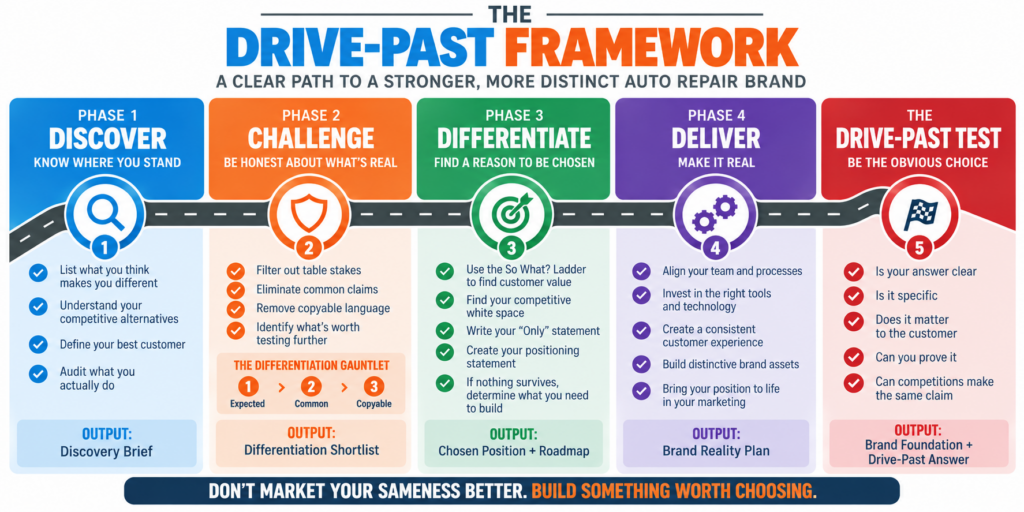
Finding meaningful differentiation requires looking deeper than your marketing. The Drive-Past Framework breaks that process into four phases:
Discover: Understand what is actually true about your customers, competitors, capabilities, and customer experience.
Challenge: Separate meaningful differences from table stakes, generic claims, and assumptions.
Differentiate: Identify a position customers care about that your shop can credibly own, or determine what you need to build to create one.
Deliver: Align the business around that position so customers actually experience the difference you promise.
Then everything faces one final validation: the Drive-Past Test.
Why should a customer drive past another good repair shop to come to yours?
The question is simple. Developing an answer that is relevant, specific, provable, and difficult for competitors to copy is much harder.
This article explains the thinking behind each phase. The Drive-Past Framework: Shop Owner Workbook provides the exercises, audits, and worksheets to apply the process to your own shop.
Phase 1: Discover
Stop Guessing About What Makes You Different
Most businesses start by asking, “What do we think makes us different?”
The problem is that owners naturally see their businesses differently than customers and competitors do.
You might believe your greatest strength is honesty, while customers value how well you explain complicated repairs. You might believe your technicians differentiate you, only to discover that nearly every strong competitor employs experienced, certified technicians. You might think customers choose you because you’re family-owned when what really keeps them coming back is convenience.
Discovery replaces assumptions with evidence. It looks at four areas:
- Who your best customers are
- What they value and struggle with
- What alternatives they have
- What your shop actually does unusually well
Your Competition Is Bigger Than You Think
Your alternatives aren’t limited to other independent shops. Depending on the customer and the problem, you may be competing with dealerships, national chains, tire stores, quick-lube facilities, specialty shops, mobile mechanics, DIY repairs, or the decision to delay the repair altogether.
Differentiation only exists in context. If every strong shop talks about honesty, integrity, quality, experience, family ownership, and customer service, those ideas occupy crowded territory.
A better question is:
What would customers experience at your shop that they wouldn’t experience in essentially the same way somewhere else?
Move From Adjectives to Evidence
Instead of saying “We’re transparent,” look at what customers actually experience. Maybe every customer receives a digital inspection with photos, technician findings, repair priorities, and pricing before approving work.
Now you’ve moved from an adjective to something observable.
The same applies to “We make auto repair convenient.” If that promise is backed by online scheduling, loaner vehicles, pickup and delivery, digital approvals, remote payment, and proactive updates, convenience isn’t just a marketing claim. It’s something you’ve built into the business.
Discover is about finding the reality underneath the adjectives.
Phase 2: Challenge
Put Your Differentiation Through the Gauntlet
Once you’ve identified what might make your shop different, determine whether those differences are actually meaningful.
A potential differentiator should survive three questions.
Is It Table Stakes?
Is this something customers should reasonably expect from any good repair shop?
Think about the opposite of your claim. If “we employ inexperienced technicians,” “we perform low-quality repairs,” or “we don’t stand behind our work” that would make someone question whether you should be in business, the positive version is probably table stakes.
Can Good Competitors Say It Too?
“We have experienced technicians.”
“We provide quality repairs.”
“We treat customers like family.”
All may be true. But if several strong competitors can credibly make essentially the same claim, it creates very little separation.
Can They Copy the Words Without Changing the Business?
If your website says, “We make auto repair convenient.” A competitor could put the same claim on its website tomorrow.
Now imagine your shop supports that promise with:
- 15 loaner vehicles
- Pickup and delivery
- Online scheduling
- Digital approvals
- Remote payment
- Proactive text updates
A competitor can copy the words. Matching the experience requires changing the business.
The strongest differentiation isn’t difficult to say. It’s difficult to replicate.
Phase 3: Differentiate
Find Something Worth Owning
Being different isn’t enough. Customers have to care about the difference.
The strongest positioning tends to exist where three things overlap:
- Customers care about it
- Your shop is exceptionally good at delivering it
- Competitors don’t deliver it equally well
That’s your potential competitive white space.
But finding it means looking beyond features and capabilities to the outcomes they create.
Customers Don’t Buy Your Capabilities. They Buy What Those Capabilities Do for Them.
If your shop has 15 loaner vehicles. That’s a capability, but the number itself isn’t the real customer benefit.
Customers care because they don’t have to arrange transportation. They can still work, take their children to school, run errands, and continue their normal routine.
The real benefit is:
Getting their vehicle repaired doesn’t have to disrupt their life.
The capability is the proof. The outcome is what the customer values.
This is the thinking behind the So What? Ladder in the Drive-Past Framework. It moves you from what your shop does to why it matters.
What If Your Shop Really Isn’t That Different?
This may be the most valuable conclusion the framework can produce.
Many good repair shops are more alike than their owners want to admit. They offer similar services, use similar equipment, employ qualified technicians, provide similar warranties, care about their customers, and deliver reasonably similar experiences.
That’s why differentiation conversations so often come back to “we care more,” “we’re honest,” “we do things right,” or “we treat people fairly.”
Those are good principles. Your best competitors probably believe them too.
If you keep arriving at honesty, quality, experience, family ownership, customer service, transparency, or “we care more,” don’t search for more creative words.
Ask a harder question:
If Our Shop Disappeared Tomorrow, What Would Customers Genuinely Lose That They Couldn’t Easily Get From Another Good Repair Shop?
If you struggle to answer, don’t manufacture differentiation.
Build it.
Seven Ways to Build Real Differentiation
Instead of asking, “How can we describe our business differently?” ask, “What do we want to become known for?”
Then ask what would need to change about the business to legitimately own that position.
1. Specialize
Become unusually good at serving a specific vehicle type, customer, problem, or need. That could mean European vehicles, hybrids, diesels, fleets, complex diagnostics, or another area where specialization creates meaningful value.
2. Remove Friction
Make an inconvenient part of auto repair dramatically easier, such as scheduling, transportation, communication, approvals, payment, or pickup.
3. Create Certainty
Reduce the uncertainty customers associate with repair costs, timelines, communication, workmanship, warranties, or future maintenance.
4. Build Expertise
Develop knowledge and capabilities that go beyond simply offering a service. Become an expert in a way customers can see and competitors would have to invest to match.
5. Change the Experience
Look beyond the repair itself. What could customers consistently experience at your shop that feels meaningfully different?
6. Change the Business Model
Sometimes the strongest differentiation comes from changing how the business operates, delivers services, or builds customer relationships.
7. Build an Asset
Invest in something competitors can’t easily reproduce, such as specialized equipment, loaner vehicles, proprietary processes, technology, training, facilities, or data.
This is where brand strategy becomes business strategy.
You stop trying to describe your existing business differently and start building a business worth describing differently.
Phase 4: Deliver
Make the Business Match the Promise
Finding a strong position isn’t enough. Your business has to live up to it.
Think of the progression this way:
Position → Promise → Proof → Experience → Message
Start with the position you want to own. Turn it into a meaningful customer promise, build the capabilities that make it credible, and make sure customers actually experience the difference.
Then communicate it.
Marketing comes last.
Imagine your position is “Auto repair for people who don’t have time for auto repair.”
Now look at the actual experience. If customers struggle to schedule, sit on hold, have no transportation options, wait for updates, can’t approve repairs digitally, and have to leave work early to pay and pick up their vehicle, the operation contradicts the position.
You don’t have a branding problem. You have a delivery problem.
Your people, processes, technology, policies, communication, and customer experience have to reinforce what you want the business to stand for.
Your Brand Should Make the Difference Easier to Recognize
Only after the business supports the position should you translate it into your brand voice, messaging, tagline, website, advertising, social media, photography, signage, and customer communication.
Your strategic differentiation answers:
Why should I choose you?
Your brand assets help customers answer:
Who was that shop again?
A great logo cannot create differentiation that doesn’t exist. But a strong brand identity can make real differentiation easier to understand, recognize, and remember.
Come Back to the Drive-Past Test
After working through all four phases, return to the original question:
Why Should a Customer Drive Past Another Good Repair Shop to Come to Yours?
A strong answer should be more than a slogan. It should reflect something real about the business, matter to the right customer, be supported by evidence, and be difficult for good competitors to claim without changing their businesses.
Compare:
“We provide quality automotive repair with exceptional customer service.”
with:
“We’re the European repair shop built for owners who want specialized European expertise without the dealership experience.”
Or:
“We’re the repair shop designed around keeping busy families moving through loaner vehicles, pickup and delivery, online scheduling, and proactive communication.”
Or:
“We help customers keep their vehicles beyond 200,000 miles through proactive maintenance planning instead of simply fixing whatever breaks next.”
These describe different businesses, not just different advertisements for essentially the same business.
Don’t Confuse Better Marketing With Better Differentiation
Marketing can amplify what makes your shop worth choosing. It cannot manufacture a meaningful difference that doesn’t exist.
Differentiation shouldn’t begin with “What should our tagline say?” It should begin with “Why should the right customer choose us over another good option?”
Sometimes the answer already exists and needs to be uncovered. Sometimes you have the right capabilities but haven’t connected them to what customers value. Sometimes you need to build the difference before you can market it.
Once you understand that, you can stop marketing your sameness more creatively and start building something customers actually have a reason to choose.
Ready to Find Out What Really Makes Your Shop Different?
Understanding differentiation is one thing. Defining what makes your shop worth choosing takes more work.
The Drive-Past Framework: Shop Owner Workbook walks you through the research, questions, audits, and exercises behind each phase:
- Discover your customers, competitors, capabilities, and actual customer experience
- Challenge assumptions and generic claims
- Differentiate by finding a position you can credibly own or deciding what you need to build
- Deliver by aligning the business and customer experience around that position
Then you’ll put everything through the Drive-Past Test.
The goal isn’t a clever tagline. It’s a stronger Brand Foundation built around one question every shop owner should be able to answer:
Why Should a Customer Drive Past Another Good Repair Shop to Come to Yours?
Don’t market your sameness better. Build something worth choosing.
Get the Free Drive-Past Framework Workbook
Author: Chris Matson is the Founder of HiBeam and an experienced automotive business and marketing professional. Since 2009, he has owned and operated independent auto repair shops while building an automotive-focused marketing agency. Earlier in his career, he served as CFO of a broadcast television group, adding financial and business leadership experience to his hands-on automotive and marketing background. Chris writes about automotive marketing, customer retention, communication, and strategies that help repair shops grow revenue.