You had 40 cars in the shop last week. This week you have 22. What changed? Many shop owners respond by spending more on advertising or offering discounts to attract new customers. While bringing in new business is important, relying on new customers alone creates an unpredictable cycle of feast and famine.
Successful auto repair shops don’t just go after new customers. They build a repeatable customer pipeline that consistently brings in new customers, keeps existing customers coming back, and reactivates customers who have stopped visiting.
A repeatable customer pipeline creates predictable revenue, improves technician productivity, and increases profitability without constantly increasing your marketing budget.
Here’s how to build one.
What Is a Customer Pipeline?
A customer pipeline is the complete journey a customer takes with your shop, from their first Google search to becoming a loyal customer who refers friends and family.
Instead of viewing each repair as a one-time transaction, a customer pipeline focuses on building long-term relationships. Every interaction moves the customer toward another visit, another service, or another referral.
For an auto repair shop, a healthy customer pipeline includes five stages:
- Attract new customers
- Deliver an exceptional first experience
- Retain customers through consistent communication
- Reactivate customers who haven’t returned
- Turn satisfied customers into advocates
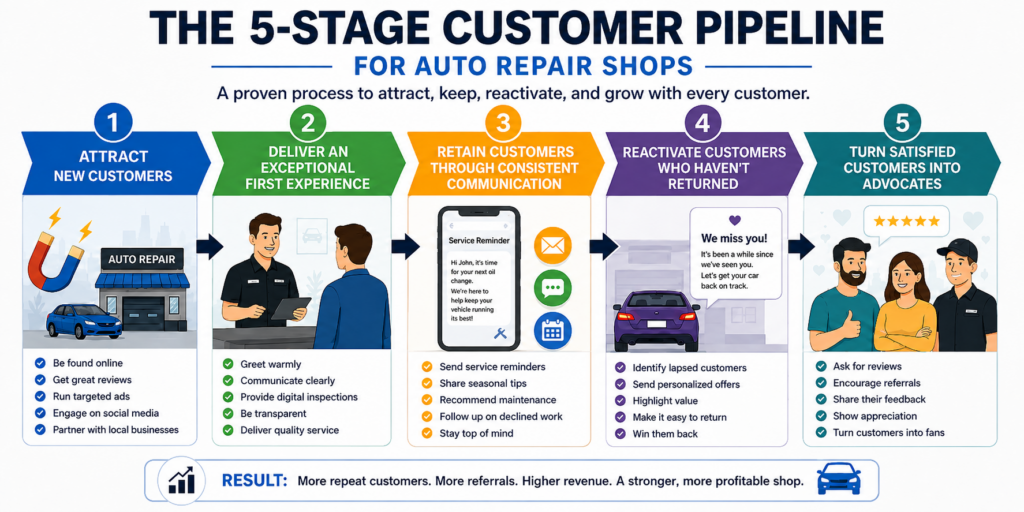
When every stage is working together, your shop grows steadily instead of depending on seasonal demand or expensive advertising.
Stage 1: Attract the Right Customers
Every pipeline starts by bringing new people through the door. The goal isn’t simply increasing traffic. It’s attracting customers who are likely to become long-term clients.
Some of the most effective ways to generate qualified customers include:
- Optimizing your Google Business Profile
- Building a strong online review presence
- Investing in local SEO
- Running targeted Google Ads
- Partner with local businesses
- Participating in community events
Many shops focus all of their marketing budget here. While this stage is important, it’s only the beginning of the customer journey.
Stage 2: Create a First Visit Worth Remembering
Your first impression determines whether a customer becomes a loyal client or a one-time visitor.
Customers remember far more than whether their oil change was completed on time. They remember how well your team communicated, whether they understood the repairs, and whether they trusted your recommendations.
Simple improvements make a significant difference:
- Clear explanations of needed repairs
- Digital vehicle inspections with photos
- Accurate estimates
- Regular text or email updates
- Friendly service advisors
- Creating an inviting lobby or check-in area
- Fast follow-up after the visit
Trust is one of the biggest drivers of customer retention. Every interaction should reinforce that your shop is transparent, knowledgeable, and easy to work with. Approaching every interaction as a shared effort to maintain the customer’s vehicle sets you up for repeat visits.
Stage 3: Turn One Visit into Many
Retention is where highly profitable shops separate themselves from average shops.
Acquiring a new customer is expensive. If that customer never returns, you’ve spent marketing dollars to generate only a single repair order.
Instead, successful shops stay connected long after the vehicle leaves the parking lot.
Consistent communication should include:
- Maintenance and oil change reminders
- Seasonal service recommendations
- Tire rotation reminders
- Car care education and tips
- Warranty follow-ups
- Thank-you messages
Customers appreciate reminders because they help them stay on top of vehicle maintenance. When done correctly they don’t feel like advertising; timely reminders provide value.
When communication is consistent, customers are far less likely to forget about your shop or choose a competitor the next time they need service.
Stage 4: Reactivate Customers Before They’re Gone
Every shop has customers who quietly disappear.
Maybe they moved, forgot about your shop, or simply delayed maintenance. Whatever the reason, waiting until they’ve been gone for years usually means you’ve lost them for good.
A better strategy is identifying customers before they’re completely lost.
One useful framework is:
- Active Customers: Visited within the last 9 months
- Lapsed Customers: Last visit 9 to 15 months ago
- Lost Customers: More than 16 months since their last visit
Lapsed customers represent one of the biggest revenue opportunities because they already know your business.
A simple reactivation campaign might include:
- A friendly “We miss seeing you” message
- A reminder about recommended maintenance
- A seasonal inspection offer
- Information about new services
- A personalized message from the service advisor
These campaigns often outperform traditional advertising because you’re marketing to people who already trust your shop.
Stage 5: Turn Happy Customers into Your Marketing Team
Satisfied customers are your most effective marketers.
People trust recommendations from friends and family far more than advertisements.
Unfortunately, many shops never ask for referrals or online reviews.
Create a process that encourages customers to share their experience by:
- Sending automated review requests
- Asking satisfied customers for referrals
- Highlighting customer testimonials
- Sharing success stories on social media
- Rewarding referral participation when appropriate
One loyal customer can introduce several new customers over time, making referrals one of the highest-return marketing channels available.
Common Gaps That Break the Pipeline
Many shops have good intentions but inconsistent systems.
Some of the most common issues include:
No Follow-Up
Customers receive an estimate but never hear from the shop again.
Declined work isn’t revisited.
Recommendations are forgotten.
Thousands of dollars in future repairs disappear simply because nobody followed up.
Inconsistent Communication
Many shops only contact customers when something is broken.
Instead, customers should hear from your shop throughout the year with helpful reminders, educational tips, and seasonal maintenance recommendations.
Treating Every Customer the Same
Not every customer needs the same message.
Someone who visited last week shouldn’t receive the same campaign as someone who hasn’t visited in 18 months.
Segmenting customers allows your communication to stay relevant.
Examples include:
- First-time customers
- High-value customers
- Fleet accounts
- Tire customers
- Maintenance customers
- Lapsed customers
- Lost customers
Relevant communication generates higher engagement and better results.
Not Measuring Performance
You can’t improve what you don’t measure.
Every shop should monitor metrics like:
- New customer acquisition
- Return on Ad Spend (ROAS)
- Customer retention/attrition rates
- Average repair order
- Survey & Net Promotor Score results
- Customer lifetime value
- Reactivation rate
- Referral rate
Tracking these numbers reveals where your pipeline is healthy and where opportunities exist.
How Automation Makes Your Pipeline Repeatable
The biggest challenge isn’t knowing what to do. It’s doing it consistently.
Service advisors are busy answering phones, greeting customers, writing estimates, and managing repairs. Manual follow-up often falls to the bottom of the priority list.
Automation solves this problem by ensuring every customer receives timely communication without creating additional work for your staff.
Automated workflows can include:
- Appointment confirmations
- Service reminders
- Declined work follow-ups
- Maintenance campaigns
- Review requests
- Customer satisfaction surveys
- Reactivation campaigns
- Referral requests
Instead of relying on memory, your shop follows the same proven process every day.
Consistency builds trust, and trust builds loyalty.
Shop Example
Take two auto repair shops that each attract 100 new customers every month.
Shop A focuses only on advertising.
Customers visit once and rarely hear from the shop again.
Every month starts from zero, requiring another investment in advertising to replace customers who never returned.
Shop B has a repeatable customer pipeline.
Every customer receives maintenance reminders, hand-written thank you cards, follow-up communication, review requests, and reactivation campaigns.
After one year:
- More customers return for scheduled maintenance.
- More declined work is recovered.
- More online reviews attract new business.
- More referrals generate additional customers.
- Revenue grows without dramatically increasing marketing spend.
The difference isn’t better technicians or lower prices.
It’s a better customer relationship strategy.
How HiBeam CRM Helps Build a Repeatable Customer Pipeline
Building a customer pipeline manually is difficult. Keeping it running consistently is even harder.
HiBeam CRM gives auto repair shops the tools to automate every stage of the customer journey.
With HiBeam CRM, you can:
- Automatically send maintenance reminders
- Follow up on declined work
- Launch customer reactivation campaigns
- Segment customers based on visit history and vehicle data
- Request online reviews automatically
- Track customer retention and lifetime value
- Measure campaign performance with real-time reporting
- Keep every customer conversation in one place
Instead of wondering where next month’s car count will come from, you’ll have a predictable system designed to generate repeat business every day.
Build a Pipeline That Works Even When You’re Busy
The best auto repair shops don’t rely on luck, discounts, or constant advertising to fill their bays.
They build systems that attract new customers, strengthen relationships, encourage repeat visits, and generate referrals year after year.
A repeatable customer pipeline doesn’t happen by accident. It happens when every customer receives the right communication at the right time.
That’s exactly what HiBeam CRM was built to do.
If you’re ready to stop chasing customers and start building lasting relationships that drive predictable growth, schedule a demo with HiBeam CRM and see how a smarter customer pipeline can transform your shop.
Author: Chris Matson is the Founder of HiBeam and an experienced automotive business and marketing professional. Since 2009, he has owned and operated independent auto repair shops while building an automotive-focused marketing agency. Earlier in his career, he served as CFO of a broadcast television group, adding financial and business leadership experience to his hands-on automotive and marketing background. Chris writes about automotive marketing, customer retention, communication, and strategies that help repair shops grow revenue.